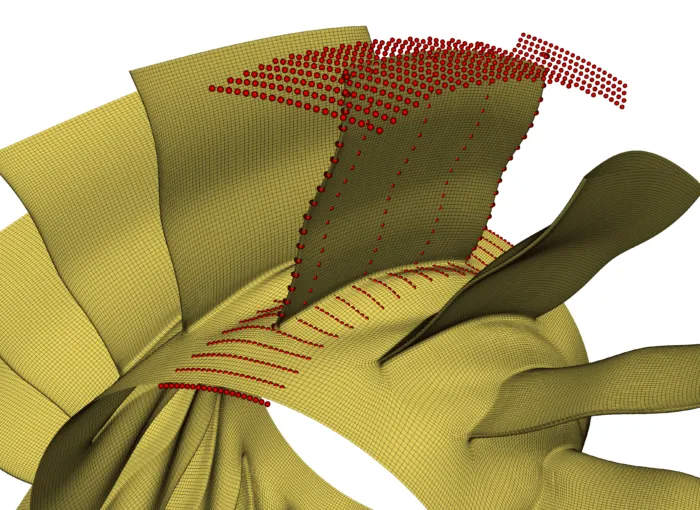
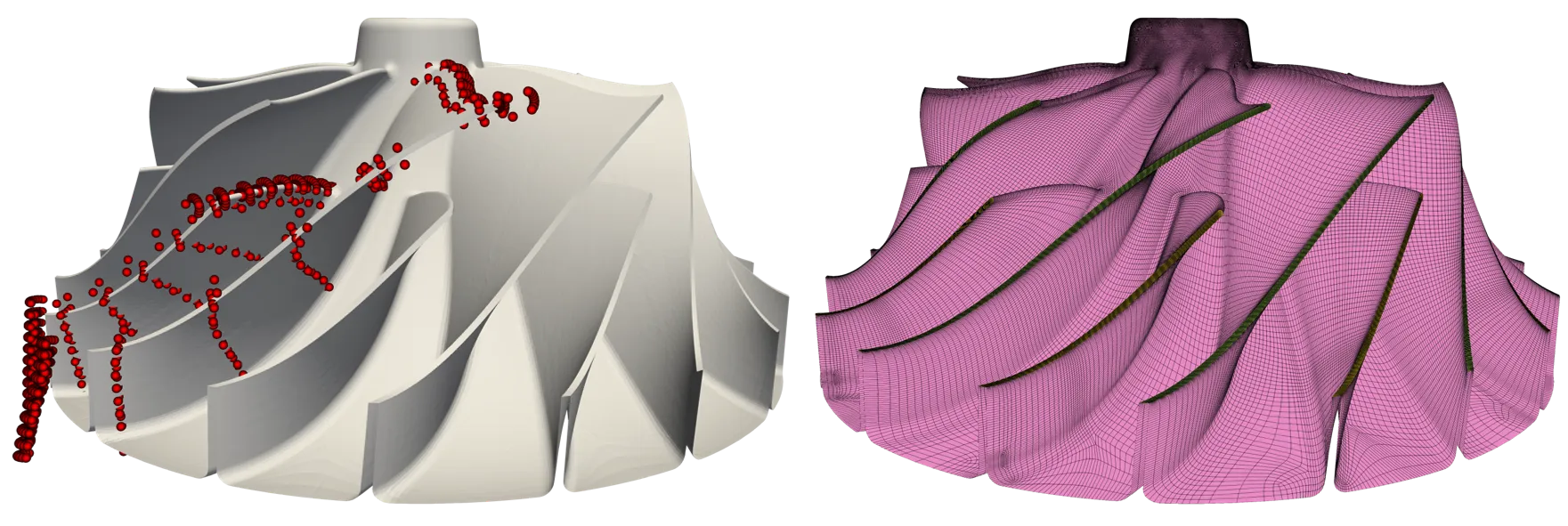
Figure 1: Automated hexahedral meshing for an axial turbine using point cloud mapping.
Word count: 1330 / 7 minutes
Discover a novel approach of automated hexahedral meshing using CAESES GridPro integration, leveraging topology templates and point cloud mapping for efficient, high-quality meshes for CFD. Key techniques like Radial Basis Functions (RBF) morphing ensure precise adaptation to shape variants.
Introduction
In the realm of CFD mesh generation, scalability is crucial, especially when dealing with multiple design variants. This is where topology template-based approaches, like those offered by GridPro CFD Solutions, shine. These block-based templates are designed with scalability in mind, allowing a single carefully constructed topology to be reused across multiple parametric shapes. This significantly reduces the simulation workflow time and the effort required for meshing, while ensuring that the grid modification remain consistent and self-similar. This consistency is invaluable for accurate comparative studies, where minor deviations in grid structure could otherwise skew results.
The block template-based approach overcomes the limitations seen in traditional structured and unstructured meshing techniques. While unstructured grids are often praised for their ease of mesh modification, they come with drawbacks like a higher number of elements, the need to constantly adjust grid size for shape changes, and compromises on cell control, simulation time, and accuracy. Structured grids, known for their cell quality and simulation accuracy, have traditionally been challenging to apply across numerous design variants due to the manual effort required.
Hexahedral meshing software, GridPro addresses these challenges by allowing simulation engineers to modify topologies manually for significant shape modification and using its in-house mesh smoothing algorithm, Ggrid, to automatically adapt and smoothen the computational mesh for smaller deviations. However, in some cases, the block positioning may not be favourable for Ggrid to ensure good mesh quality, resulting in highly skewed or folded cells.
To further streamline the process, GridPro has developed a topology mapping feature in collaboration with Caeses, that automatically maps the topology from the baseline model to its shape variants. This is achieved by using point cloud pairs to map the topology from the baseline model to the variation, ensuring that even complex design variations maintain the same level of grid quality as the original model. This optimization-based mesh morphing saves time and enhances the accuracy and reliability of simulations across multiple design iterations.
Structured vs Unstructured Meshing: The GridPro Advantage
In computational fluid dynamics (CFD) and design optimization workflows, especially those involving parametric studies, mesh quality and consistency play a critical role in ensuring accurate and comparable simulation results.
Unstructured grids, while easier to adapt, have certain limitations and disadvantages:
- Re-Meshing Required for Every Variant: Any change in geometry typically requires full remeshing, which is time-consuming and prone to variability.
- Inconsistent Cell Distribution: Mesh quality and cell placement can differ between variants, leading to result scatter unrelated to physics.
- Post-Meshing Cleanup Often Needed: Small changes in geometry can cause distorted cells or poor-quality elements that require manual correction.
- Longer Meshing Time for Parametric Loops: Repeated meshing adds significant overhead to parametric workflows, especially in large-scale studies.
In contrast, structured grids provide:
- Topology Reusability: Once a block topology is created, it can be reused across all geometry variations with minimal or no manual adjustments.
- Automation-Ready: Easy to integrate into automated design loops (DOE, optimization) for high-throughput studies.
- Consistent Cell Distribution: Maintains consistent element distribution and alignment across all variants, ensuring reliable comparison of results.
- Accurate Near-Wall Resolution: Boundary layers and critical flow regions maintain high-quality structured cells even as geometry evolves.
- Smooth Grid Transition: Smooth variation of cell sizes across the domain reduces numerical diffusion and enhances convergence.
Adapting Topology to Geometry Changes in Computational Simulations
Topology morphing in CFD based on changes in geometry is a crucial concept. It involves adapting a predefined mesh topology to fit a parametrically changing geometry while preserving essential properties such as topology preservation, element size, aspect ratio, and overall mesh quality. This process ensures that the computational domain remains accurate and functional as the geometric design evolves.
In practice, topology adjustment can be achieved through various methods. One common approach is the spring analogy, where topology elements are connected by imaginary springs. When the geometry deforms, these springs adjust the block automatically, helping maintain a smooth transition. Additionally, smoothing algorithms can be applied to refine the block quality after the boundary nodes have been adjusted.
A more advanced technique involves using Radial Basis Function (RBF) Interpolation to fine-tune node positioning in response to shape deformation. This method is particularly effective for ensuring that the topology conforms precisely to the deformed design variants.
Our Approach: Point Cloud Mapping
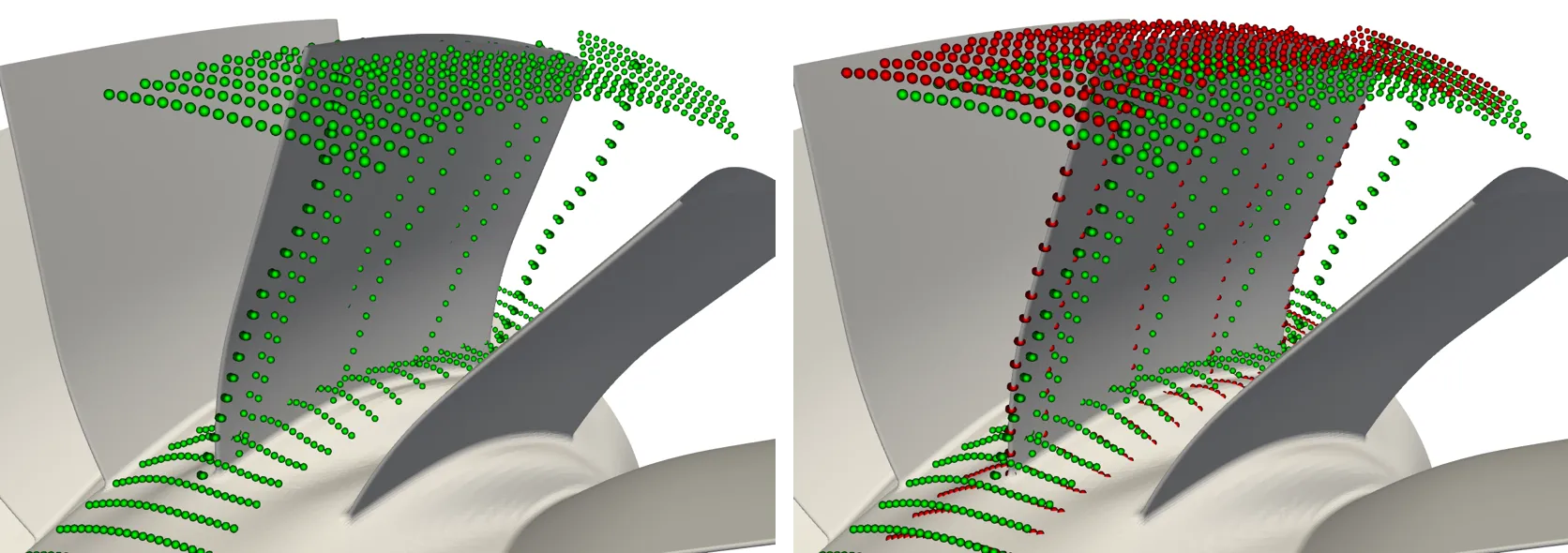
In our workflow, two similar parametric models are compared, we identify a random set of nodes on the initial and deformed geometries and create a map. This map is further used to morph the topology from one design to another.
By leveraging these techniques, we can effectively morph the topology to accommodate changes in geometry, ensuring consistent grid generation for accurate and reliable simulations.
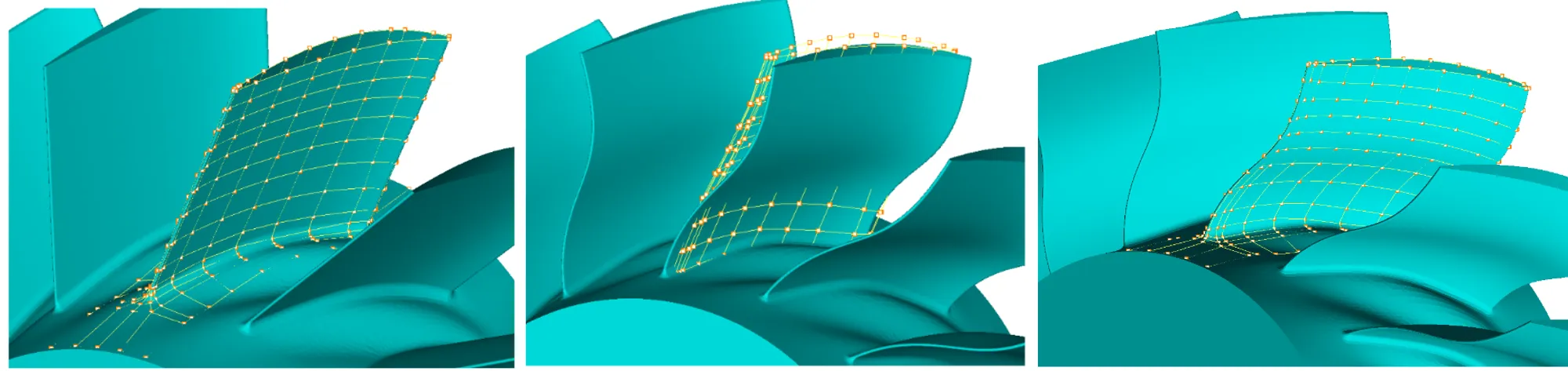
Workflow Overview
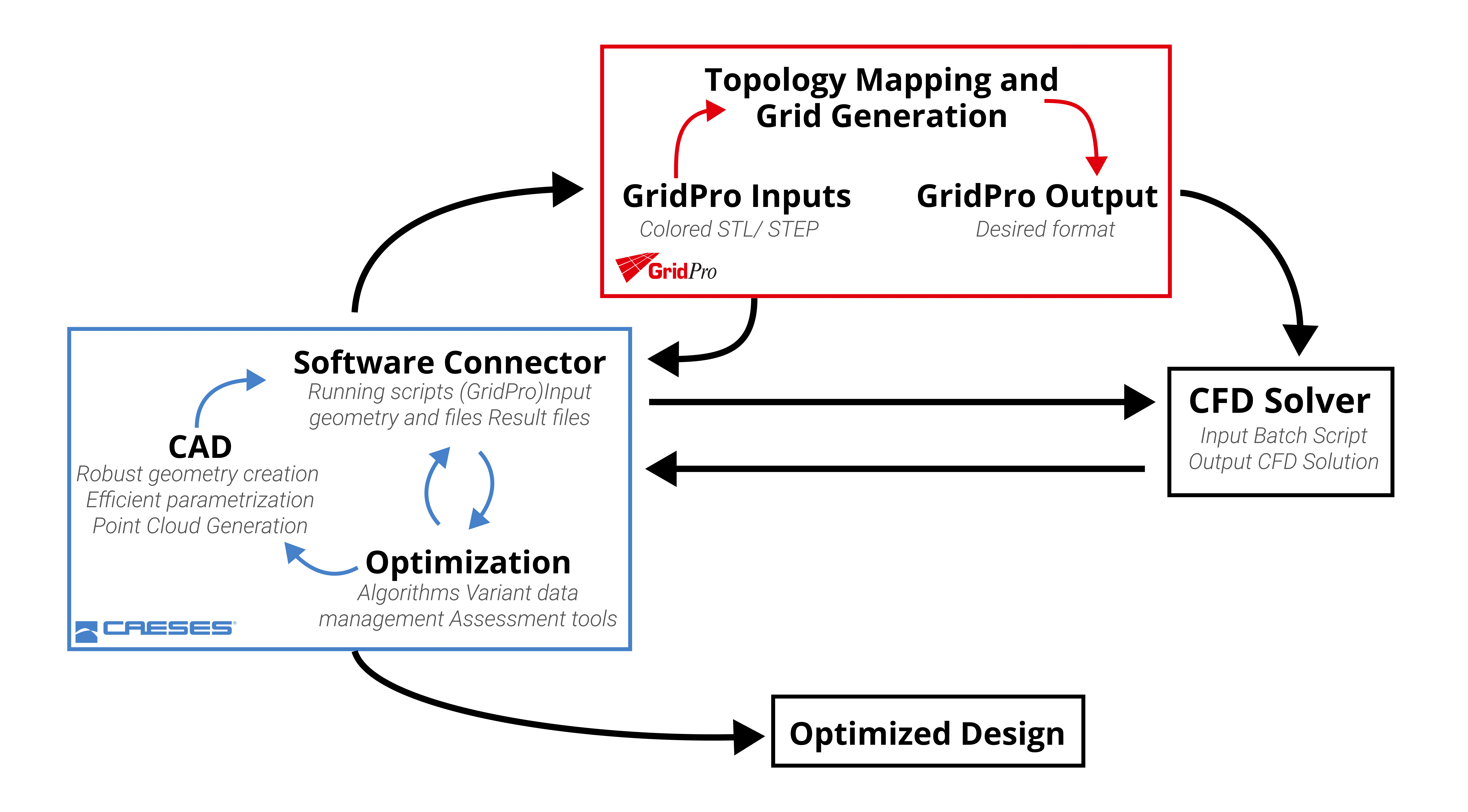
To test this new adaptive meshing, an axial turbine blade was selected as the first test case. Initially, a baseline wireframe topology for the turbine blade is constructed manually in GridPro meshing software using the UI. This is the only step requiring human intervention. Once the baseline topology is established, it serves as a template for automated mesh generation across various design variants within the Caeses platform.
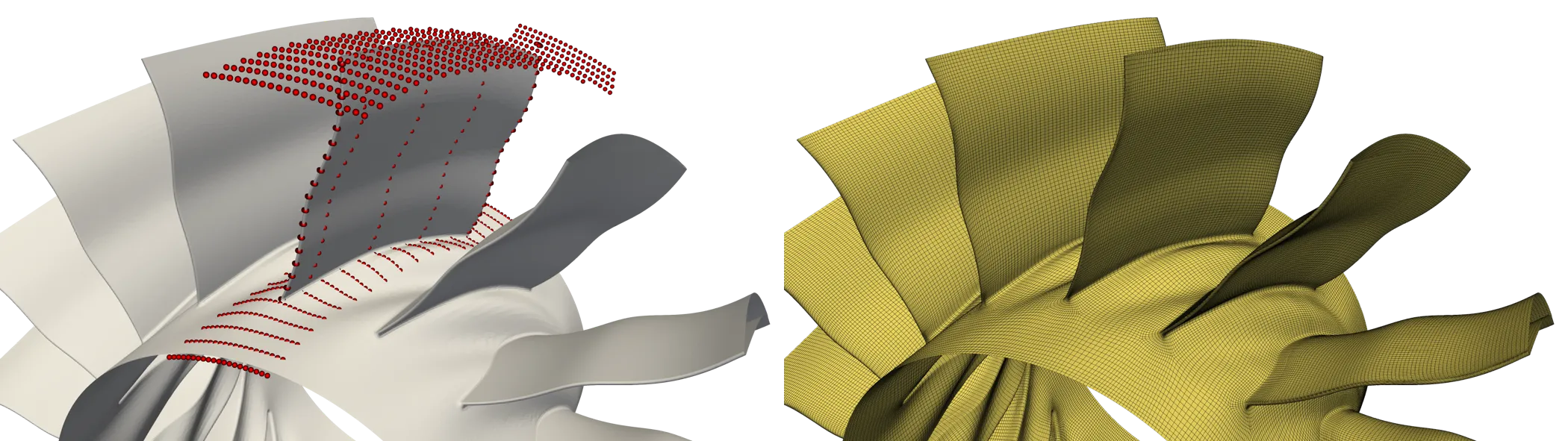
Next, GridPro is integrated into Caeses using an integration script, creating a closed-loop system. The script is designed to manage surface mesh generation, CAD file conversion, topology adaptation, and grid generation. In this setup, Caeses parametrically modifies the axial turbine blade shape to produce different variants, while GridPro automatically generates multi-block structured meshes for each variant without further user involvement.
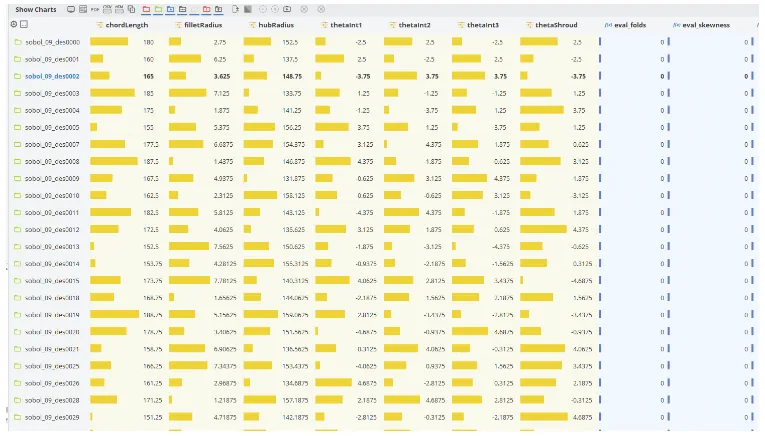
For the axial turbine test case, 50 parametric modeling variants were generated by varying 7 parametric variables. The baseline topology, created in approximately 45 minutes, was used as a template to generate structured grids for the remaining 49 design exploration variants. The entire process took around 350 minutes, or roughly 6 hours.

Case Studies
- 15 variables, 50 variants
- Baseline topology – 6 minutes
- Avg. mesh time per case: 7 mins
- Total: 6 hours
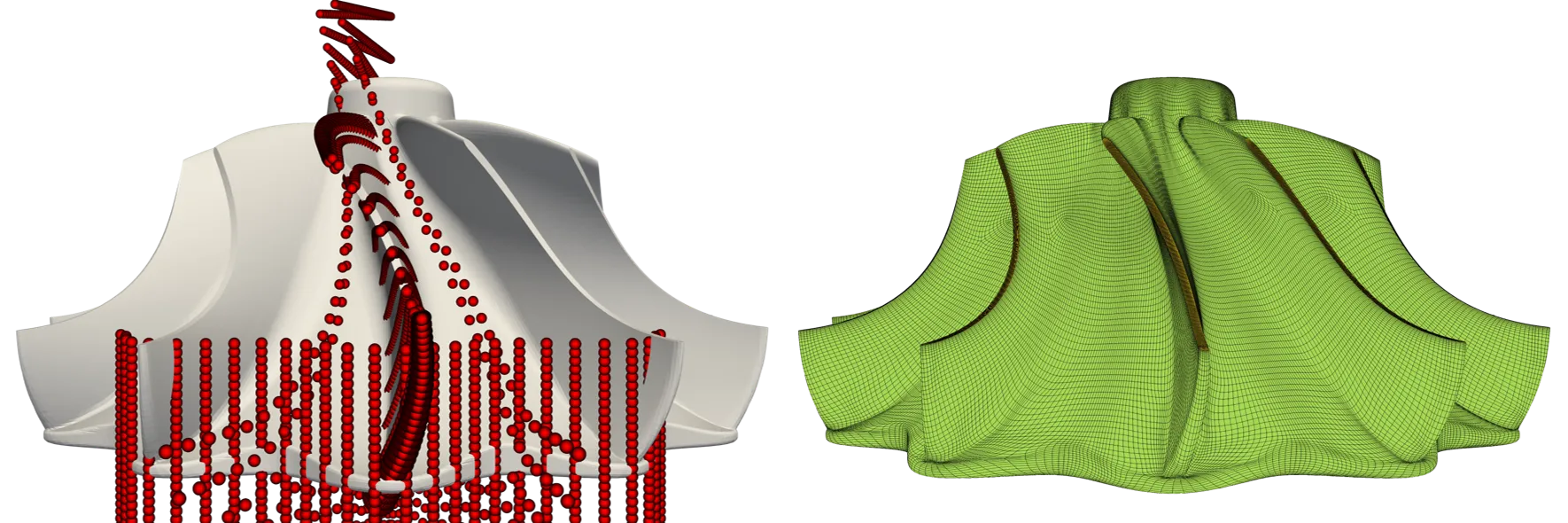
- 12 variables, 50 variants
- Baseline topology – 2 mins
- Avg. mesh time per case: 3 mins
- Total: 2.5 hours
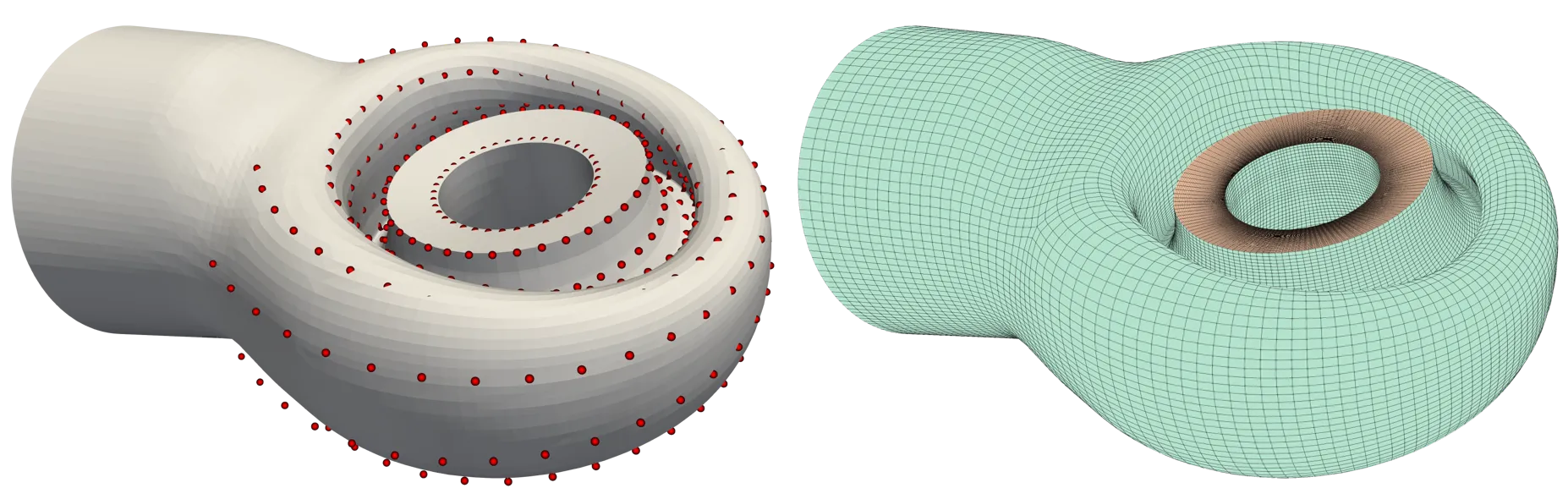
- 15 variables, 50 variants
- Baseline topology – 2 mins
- Avg. mesh time per case: 3 mins
- Total: 2.5 hours

- 32 variables, 50 variants
- Baseline topology – 15 mins
- Avg. mesh time per case: 7 mins
- Total: 7 hours
Ready to Automate Your Meshing Workflow?
GridPro’s intelligent structured meshing automation solution reduces manual effort and maximizes accuracy—making it ideal for design optimization in CFD.
Schedule a free demo or contact us to see how GridPro can accelerate your simulation pipeline.
Conclusion
The adopted approach is effective in automating parametric geometric meshing. The developed workflow, which utilizes topology templates and point cloud mapping, significantly reduces the manual effort traditionally required in structured mesh modification. By leveraging techniques such as Radial Basis Function (RBF) interpolation in meshing, the method ensures that topology adapts accurately to geometric changes, preserving mesh quality and ensuring reliable simulation outcomes.
The successful application of this methodology to axial turbines, radial turbines, exit casings, compressor volutes, and centrifugal compressors demonstrates its efficiency in generating high-quality grids for multiple design variants with minimal user input. The ability to mesh 50 geometric variants within six hours highlights the approach’s scalability and robustness, reinforcing its potential for widespread adoption in industrial applications of engineering simulation.
Acknowledgement
We sincerely thank Caeses for providing all the geometries, which was crucial for generating the structured mesh. More details about Caeses work can be found at Caeses Shape deformation and morphing.