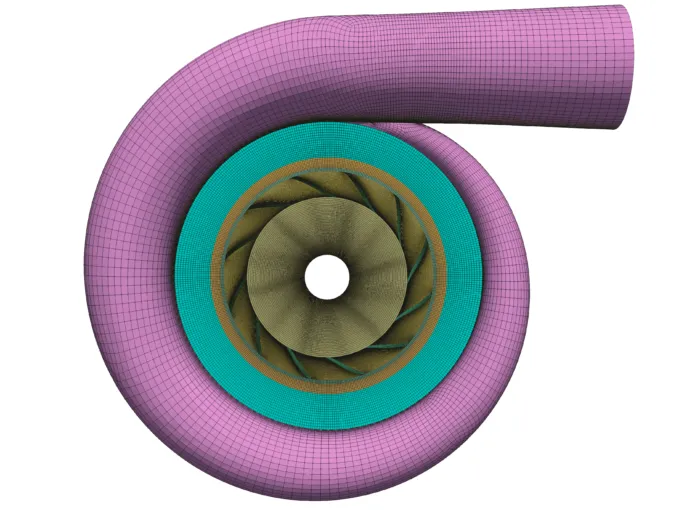
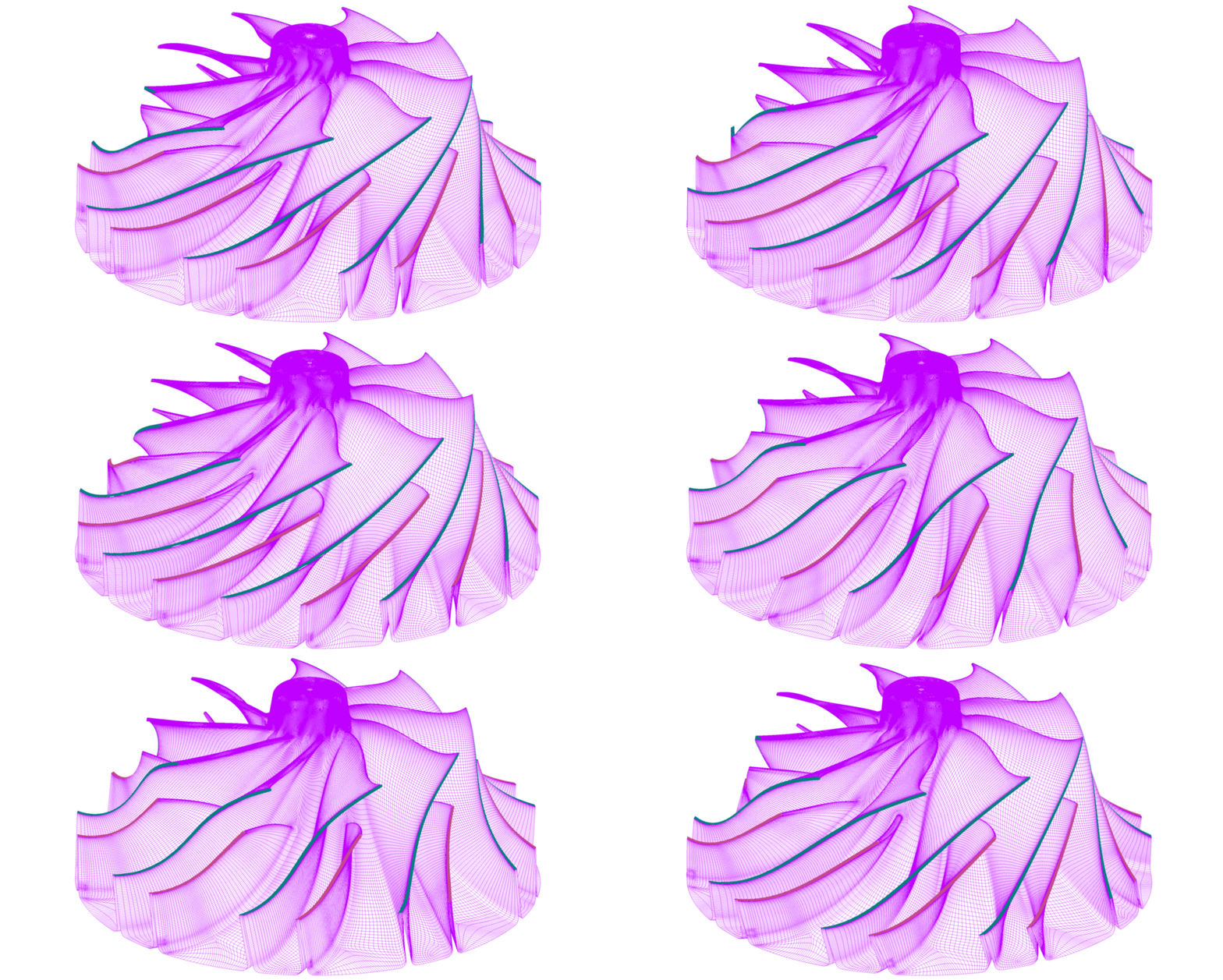
Figure 1: Structured multiblock mesh for Turbocharger compressors.
Word count: 1358 / 7 minutes
Optimizing Turbocharger Performance with CFD-Driven Compressor Design and Automated GridPro Meshing Tools
Introduction
Turbochargers have transformed internal combustion engines by significantly boosting power output without increasing engine size. At the core of this innovation is the centrifugal compressor, a key component responsible for compressing and supplying air to enhance combustion efficiency. Its performance depends on careful impeller design, aerodynamic optimization, and advanced computational techniques.
CFD simulation plays a crucial role in refining compressor aerodynamics, allowing engineers to enhance compressor efficiency and turbocharger performance. Structured meshing for compressors further improves the accuracy of these simulations. Advanced structured meshing GridPro tools like Xpress Volute and Xpress Blade automate the hexahedral meshing process, reducing design iteration time while ensuring high-quality grids, which are essential for precise CFD analysis for compressors and performance optimization.
Optimizing Compressor Performance for Efficient Turbocharging and Engine Power
The compressor in a turbocharger plays a crucial role in enhancing engine performance by increasing the density of the intake air. By compressing incoming air, it ensures a higher oxygen supply, which leads to more efficient combustion, improved fuel efficiency in turbocharged engines, and greater power output. The effectiveness of the compressor directly influences the overall efficiency of the turbocharger, making its design a key aspect of performance optimization.
Several factors impact compressor performance, with the pressure ratio being one of the most significant. This determines the level of air compression achieved, directly affecting engine output. To deliver the required mass flow without instability, the compressor’s flow characteristics must be carefully designed. Achieving the right balance between these factors ensures maximum efficiency, durability, and aerodynamic performance.

Compressor Efficiency: Its role in Fuel Savings, Emissions, and Performance Optimization
Compressor efficiency plays a crucial role in determining the overall performance of both the turbocharger design and the engine. One of its most significant impacts is on fuel efficiency in turbocharged engines. In a turbocharged engine, higher compressor efficiency reduces the energy required for the pumping cycle, directly improving Brake Specific Fuel Consumption (BSFC). By minimizing energy losses, an efficient compressor ensures that more of the fuel’s energy is converted into useful work rather than being wasted.
A more efficient compressor also contributes to lower emissions by reducing fuel consumption, helping engines comply with increasingly stringent environmental regulations. In heavy-duty applications, where high pressure ratios are required for effective combustion, improved efficiency ensures that the necessary boost is achieved with minimal energy input. This not only enhances performance but also expands the compressor’s operating range, allowing it to function effectively across various engine speeds and loads. Additionally, optimizing compressor aerodynamics reduces noise generation, an essential consideration in modern turbomachinery design.
Overcoming Aerodynamic, Acoustic, and Manufacturing Challenges in Compressor Design
Designing highly efficient compressors presents a range of complex challenges that engineers must carefully address to optimize turbocharger performance. One of the most significant difficulties arises from the high tip speeds at which turbocharger compressors operate. These high speeds create intricate flow structures, including shock waves in transonic designs, which can lead to substantial efficiency losses. Managing these effects requires precise aerodynamic optimization to minimize performance penalties.
Another critical challenge is tip leakage, where airflow escapes through the gap between the blade tip and the casing. This leakage not only reduces efficiency but also increases noise levels, making it essential to develop sealing techniques and design strategies that minimize these losses. Many modern compressors incorporate splitter blades to extend their operating range, but their effectiveness depends heavily on proper design. Poorly designed splitter blades can disrupt airflow, leading to mismatches and reduced overall efficiency.
In addition to aerodynamic considerations, modern compressors must also meet stringent noise-reduction requirements. Balancing high aerodynamic efficiency with low noise emissions is a major challenge, requiring innovative aeroacoustic optimization. Engineers must also navigate the trade-offs between achieving a wide operating range and maintaining high efficiency, as improving one often comes at the cost of the other.
Furthermore, traditional manufacturing constraints can limit the ability to implement optimal blade designs, though advancements in precision manufacturing techniques, such as point milling, are helping to overcome these limitations.
Addressing these challenges demands a combination of advanced computational tools, innovative design approaches, and cutting-edge manufacturing solutions.
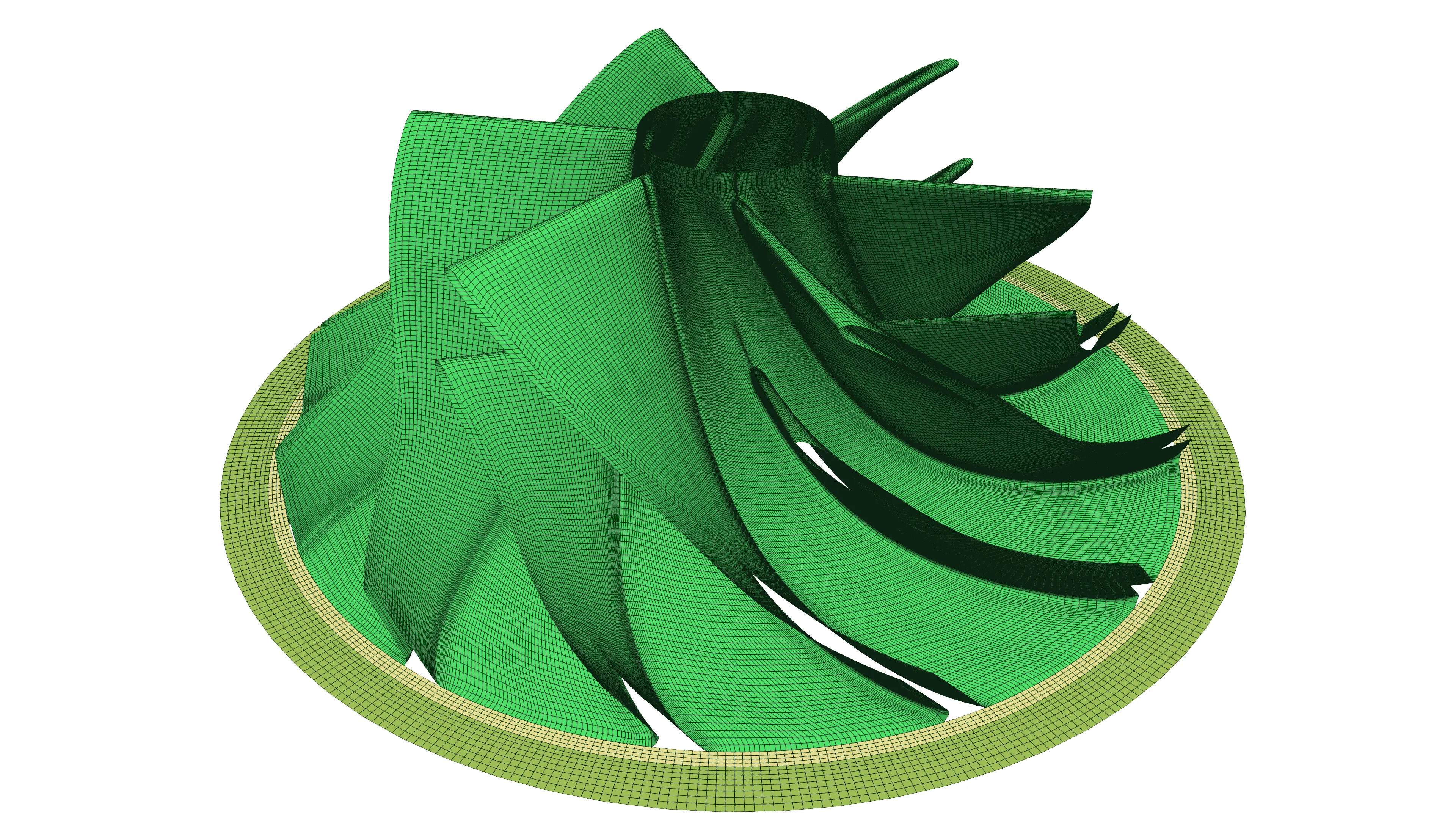
Enhancing Turbocharger Compressor Design with CFD for Optimal Performance and Efficiency
CFD simulation plays a vital role in modern compressor design by offering detailed insights into fluid dynamics within the impeller and volute. With CFD, engineers can analyze complex flow structures, turbulence, and loss mechanisms, such as shock waves, tip leakage, and secondary flow. This allows for the optimization of compressor aerodynamics and also helps to minimize performance losses.
Moreover, CFD analysis for compressors enables engineers to assess how design changes impact key parameters like compressor efficiency, pressure ratio, and operating range. It also provides the capability to evaluate compressor performance under various operating conditions, including off-design scenarios. By reducing the need for extensive physical testing, CFD accelerates the design process, identifies potential surge and stall conditions, and ultimately enhances the reliability and performance of the compressor.
By leveraging CFD simulations, engineers can iteratively refine designs to ensure optimal performance and reduced time-to-market.
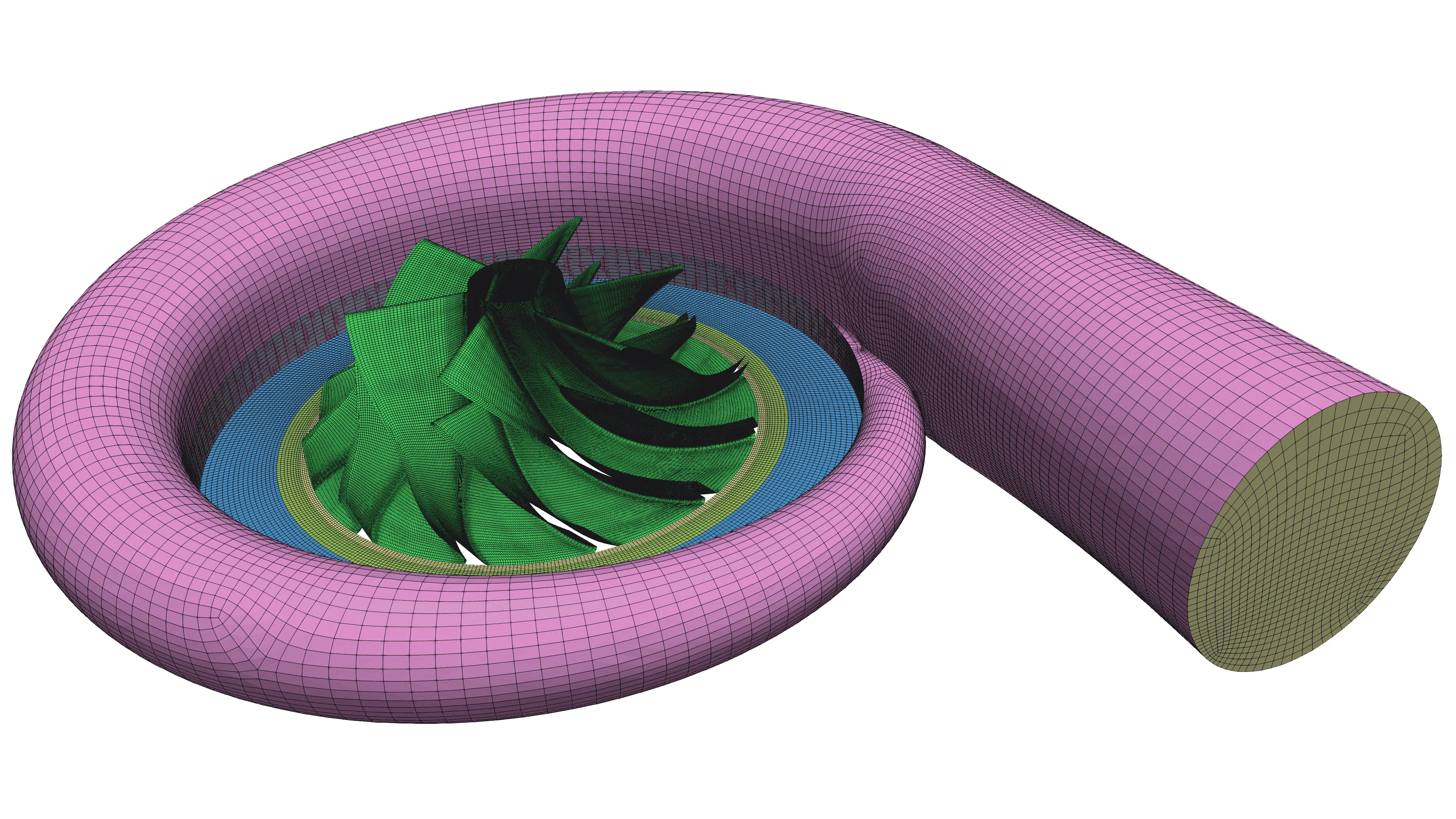
Optimizing Mesh Quality for Accurate and Reliable CFD Analysis of Turbocharger Compressors
Mesh generation is a critical component in achieving accurate CFD simulations for compressor analysis. It defines the resolution of the flow field and plays a significant role in the stability and convergence of the numerical simulation. The density of the mesh is a key consideration, as a finer mesh provides higher resolution but also increases computational costs. Mesh sensitivity studies help identify the optimal density, ensuring that the solution is independent of the mesh size.
Another important factor is the resolution of the boundary layer, which is essential for accurately capturing wall effects and predicting losses in the flow. Grid smoothness is equally crucial as it helps minimize numerical errors and ensures stable simulations. The mesh must also meet certain quality standards, such as maintaining proper aspect ratio, minimum angle, and expansion factor to guarantee reliable results.
By carefully designing and optimizing the mesh, CFD simulations can accurately capture complex flow phenomena like tip leakage, secondary flows, and shock waves, all of which play a vital role in determining compressor performance.
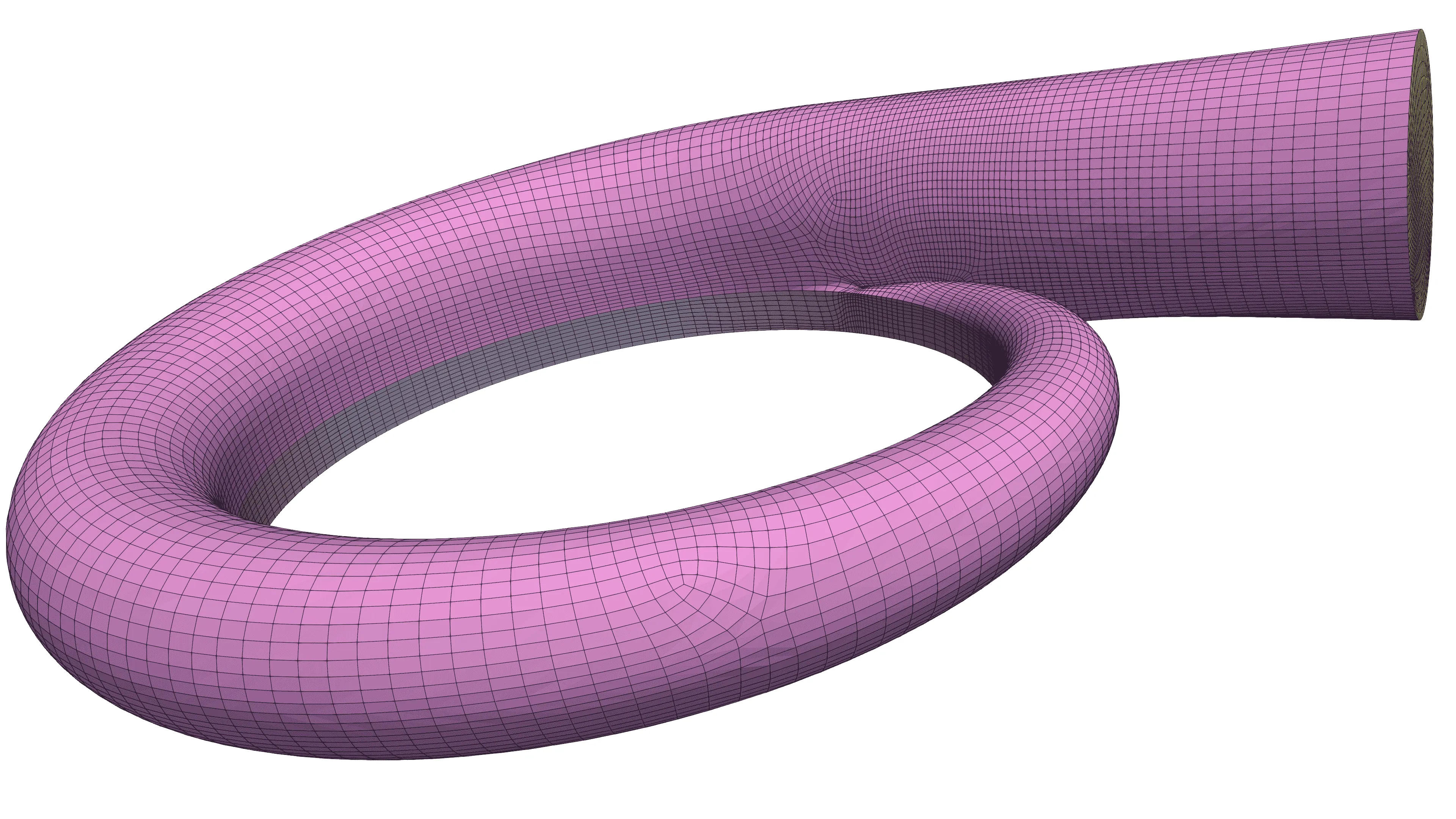
Hexahedral Meshing: Enhancing Accuracy and Efficiency in CFD Analysis of Turbocharger Compressors
Hexahedral meshing is widely preferred in the CFD analysis of compressors because it offers superior accuracy and computational efficiency. One of the main advantages of hexahedral grids is their ability to reduce numerical diffusion, leading to more precise flow predictions, particularly in complex phenomena such as boundary layers and shock waves.
In addition to better accuracy, these meshes require fewer elements to achieve high resolution, which lowers computational costs and improves solver efficiency. Hexahedral meshes also enhance convergence stability by supporting smoother flow transitions and more accurate gradient resolution, making the simulation process more reliable. Furthermore, they provide efficient boundary layer capture, as their structured nature allows for well-aligned cells near solid walls, crucial for accurate near-wall flow predictions.
These characteristics make structured hexahedral meshing the ideal choice for critical regions in compressor design, such as the impeller passage, volute tongue and vaneless diffuser, where precise flow analysis is essential.
Automating High-Quality Meshing for Impellers and Volutes with GridPro
GridPro’s automated meshing tools simplify and accelerate the meshing process for compressor impellers and volutes. One of the key advantages of GridPro is its ability to enhance solution accuracy. With features like the Xpress Volute and Xpress Blade meshing tools, it captures complex flow fields with high precision, leading to better performance predictions.
The tool’s versatile blocking structure adapts to various geometric variations, providing flexibility in design. By automating the meshing process, GridPro minimizes manual errors, ensuring consistent mesh quality and improving the overall integrity of the simulation. This automation also accelerates the workflow, allowing for faster iterations and quicker optimization, which is essential for effective compressor design.
Additionally, GridPro seamlessly integrates with CAD tools and flow solvers, streamlining both the design and simulation phases. The software excels at capturing intricate flow dynamics, such as swirl patterns and the tongue region, which are crucial for optimizing turbomachinery performance. With features like 1-1 connected meshing, it improves accuracy in tip flow simulations, ultimately reducing CFD simulation time while maintaining high reliability and accuracy.
Conclusion
Compressors are fundamental to turbocharger performance, and their design requires detailed CFD analysis to ensure efficiency and reliability. Structured hexahedral meshing plays a crucial role in obtaining accurate CFD results, and GridPro’s automated meshing tools streamline the process, reducing time while maintaining precision. As turbocharger technology advances, leveraging automated meshing and high-fidelity CFD simulations will continue to be essential in achieving optimal compressor designs.
Acknowledgement
We sincerely thank CFDsupport for providing the compressor geometry, which was crucial for generating the structured mesh. The compressor model was created using CFturbo software. More details about CFDsupport’s work can be found at Centrifugal Compressor.
Further Reading
- Automated Hexahedral Meshing of Gerotor Pumps
- Automation of Hexahedral Meshing for Scroll Compressors
- Automated Structured Meshing of Fuel Rod Assembly
- Volutes – Did Nature or Need Inspire Turbo-Machines?
References
1. “3D Multi-Disciplinary Inverse Design Based Optimization of a Centrifugal Compressor Impeller”, 2013.
2. “A 3D Automatic Optimization Strategy for Design of Centrifugal Compressor Impeller Blades” – K.F.C. Yiu and M. Zangeneh, ASME, 1998.
4. “3. “ADT Publication_A DETAILED LOSS ANALYSIS METHODOLOGY FOR CENTRIFUGAL COMPRESSORS”, 2019.
5. “Application of 3D Inverse Design Method on a Transonic Compressor Stage“, 2021.
6. “Design and optimization of compressor for a fuel cell system on a commercial truck under real driving conditions”, Institution of Mechanical Engineers, 2023.
7. “Design of a Centrifugal Compressor Stage and a Radial-Inflow Turbine Stage for a Supercritical CO2 Recompression Brayton Cycle by Using 3D Inverse Design Method“, 2017.
8. “Design of a Mixed-flow Transonic Compressor for Active High-lift System Using a 3D Inverse Design Methodology”, ASME, 2020.
9. “Development of a high performance centrifugal compressor using a 3D inverse design technique“, 2010.
10. “Investigation of an Inversely Design Centrifugal Compressor Stage” – M. Schleer, S. S. Hong, M. Zangeneh, ASME, 2003.
11. “Multi Objective Design of a Transonic Turbocharger Compressor with Reduced Noise and Increased Efficiency“, ASME, 2019.
12. “Multi-point Optimisation of an Industrial Centrifugal Compressor with Return Channel by 3D Inverse Design”, ASME Turbo Expo.
13. “Optimization of 6.2to1 Pressure Ratio Centrifugal Compressor Impeller by 3D Inverse Design”, ASME Turbo Expo, 2011.
14. “Redesign Of A Transonic Compressor Rotor By Means Of A ThreeDimentional Inverse Design Method A Parametric Study“, ASME, 2005.
15. “Redesign of a Compressor Stage for a High-performance Electric Supercharger in a Heavily Downsized Engine”, ASME, 2017.
16. “Tandem Blade Centrifugal Compressor Design Optimization 3D Inverse Design” – Ricardo Oliveira, Luying Zhang, European Conference on Turbomachinery Fluid dynamics & Thermodynamics, 2023.
17. “The Design of High Temperature Heat Pump Compressor Using the Inverse Method“, ASME, 2023.