
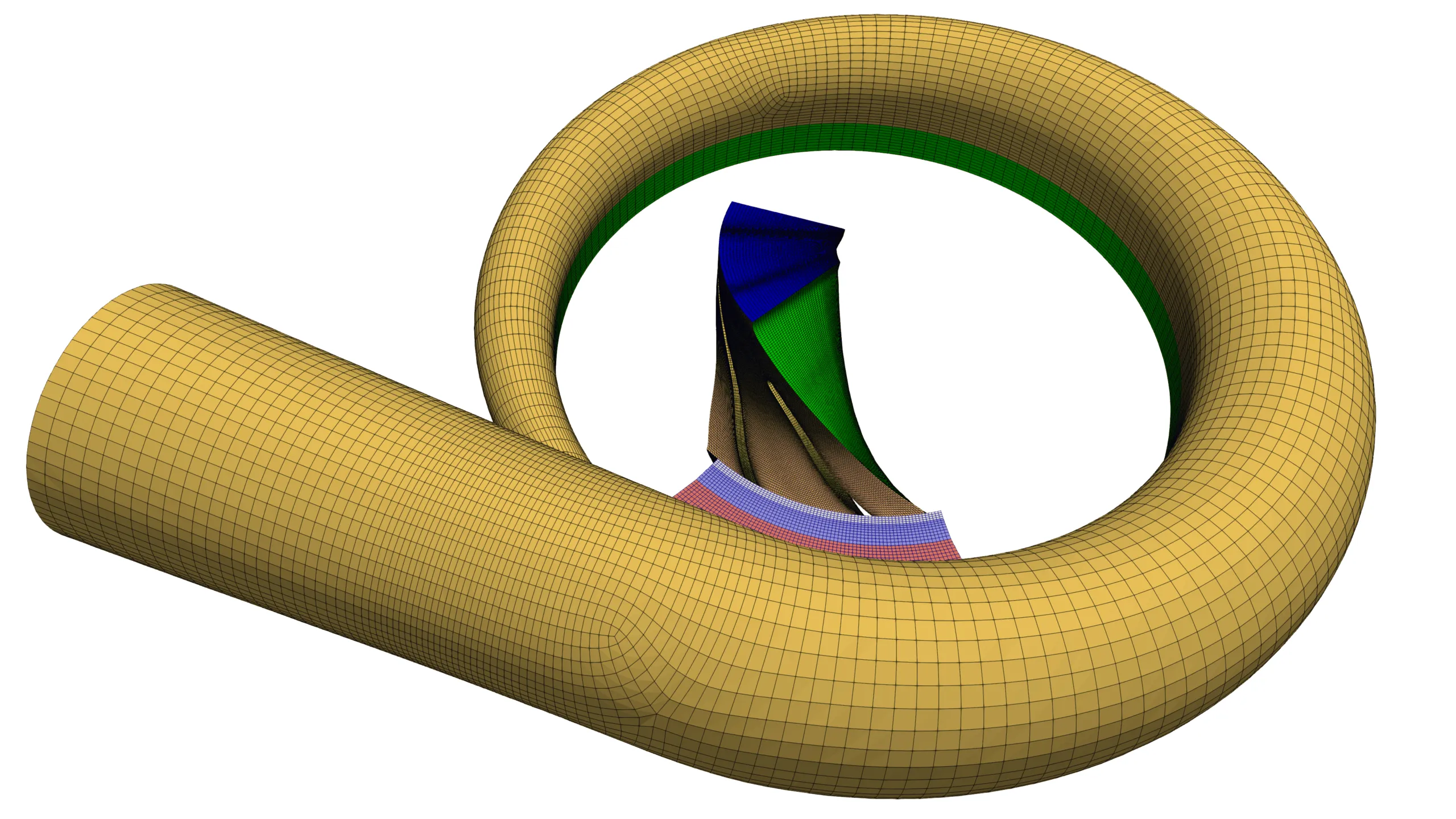
Figure 1: Structured multi-block meshing of a heat pump compressor.
1209 words / 6 minutes read
Shifting to low-GWP refrigerants is reshaping centrifugal compressor design for heat pumps. This blog reveals how structured hexahedral meshing with GridPro empowers CFD engineers to tackle real-gas effects, optimize performance, and accelerate innovation—ensuring sustainable, high-efficiency compressors that meet the challenges of a changing HVAC landscape.
Introduction
As global energy policies tighten and environmental awareness rises, the HVAC and energy industries are shifting toward low-Global Warming Potential (GWP) refrigerants. In this evolving landscape, centrifugal compressors used in heat pumps are undergoing critical redesign. These systems must now meet higher performance and sustainability standards while accommodating complex thermodynamic behaviors. CFD engineers and R&D managers play a pivotal role in ensuring these compressors adapt to new refrigerants without compromising efficiency or reliability. Structured meshing, particularly hexahedral multiblock techniques, is emerging as a powerful enabler of accurate CFD simulations tailored to this transformation.
The Refrigerant Transition Challenge
The push to replace high-GWP refrigerants like R134a is driven by both regulatory mandates and sustainability goals. New options such as R1234yf, R1234ze(E), CO₂, and ammonia offer significantly lower environmental impact. However, these alternatives introduce design complications, including altered thermophysical properties, higher pressures, and non-ideal fluid behaviors. Transitioning to these refrigerants isn’t as simple as swapping fluids; it requires a re-evaluation of compressor design to ensure optimal thermal and mechanical performance.
CFD simulations play a central role in assessing how different refrigerants impact efficiency, mass flow rate, pressure ratio, and power requirements. These metrics are influenced by a refrigerant’s specific heat ratio, compressibility, and speed of sound. For instance, R1234ze(E), with a lower speed of sound than R134a, can result in higher pressure ratios at the same rotational speeds but may require adjustments to blade angle and diffuser geometry to maintain performance. These evaluations are only reliable when supported by high-fidelity meshes that resolve critical features of the compressor flow path.
CFD’s Role in Heat Pump Compressor Redesign
Accurate CFD modeling enables engineers to simulate real-world operation and iterate compressor designs quickly. With low-GWP refrigerants, real gas effects become prominent and must be incorporated using equations of state like Peng-Robinson or Redlich-Kwong. Property libraries such as NIST REFPROP or CoolProp are commonly integrated into CFD workflows to provide refrigerant-specific data.
CFD also supports flow visualization and loss analysis, helping engineers refine impeller and diffuser shapes to reduce aerodynamic losses. Identifying zones of high entropy generation, flow recirculation, or separation enables targeted geometric modifications. For example, blade tip leakage losses and flow detachment in the diffuser region are critical for compressors using refrigerants like CO₂ or hydrocarbons operating at high pressures. Well-resolved CFD studies guide designers in mitigating these effects through blade curvature optimization, hub contouring, or diffuser vane adjustments.
Moreover, system-level performance can be predicted through CFD results linked with thermodynamic cycle simulators. This integration allows teams to evaluate how compressor performance translates into system COP under variable operating conditions. Such an approach provides a holistic view and supports informed decision-making on refrigerant choice and component sizing.
Why Mesh Quality Matters
In the CFD workflow, mesh generation directly influences the accuracy, stability, and convergence of the simulation. In centrifugal compressors, flow behavior is strongly affected by complex geometry and rotating machinery effects. Components such as impellers with main and splitter blades, tight tip clearances, and curved volute channels introduce abrupt velocity gradients, secondary flows, and shocks.
Mesh resolution must be high enough to capture boundary layers, pressure gradients, and thermal interactions. Especially in wall-bounded regions, achieving target y+ values (typically <1) is necessary to ensure compatibility with turbulence models like k-ω SST. This is vital when simulating flow separation or heat transfer within the volute or impeller shroud.
Mesh quality is equally important when working with real gas models. Rapid property changes due to pressure and temperature fluctuations can lead to convergence issues if the mesh is distorted or insufficiently refined. A mesh with good orthogonality, low skewness, and gradual stretching supports robust simulations even under these challenging conditions.
A well-executed grid independence study further enhances credibility by verifying that simulation outputs remain consistent across different mesh densities. Balancing computational cost and accuracy, such studies help teams standardize mesh sizes while maintaining trust in the results.
Benefits of Structured Hexahedral Meshes
Structured hexahedral meshes are ideal for turbomachinery simulations because they offer higher numerical accuracy and control than unstructured meshes. By aligning elements with the main flow direction, they minimize interpolation errors and numerical diffusion, which is particularly advantageous in high-gradient regions near blade surfaces.
They also facilitate cleaner layering near walls, enabling more reliable use of wall-resolved turbulence models. This becomes especially important when analyzing centrifugal compressors operating under transonic or off-design conditions, where minor differences in wall shear can influence performance and efficiency.
In post-processing, structured meshes allow engineers to interpret simulation results more clearly. Streamlines, pressure contours, and velocity vectors derived from well-ordered grids yield more consistent visualizations, helping teams identify flow anomalies and validate design improvements. The predictability and stability of structured meshes also reduce solver crashes and improve convergence speed—benefits that accumulate over repeated design cycles.
GridPro’s Role in Advanced Meshing
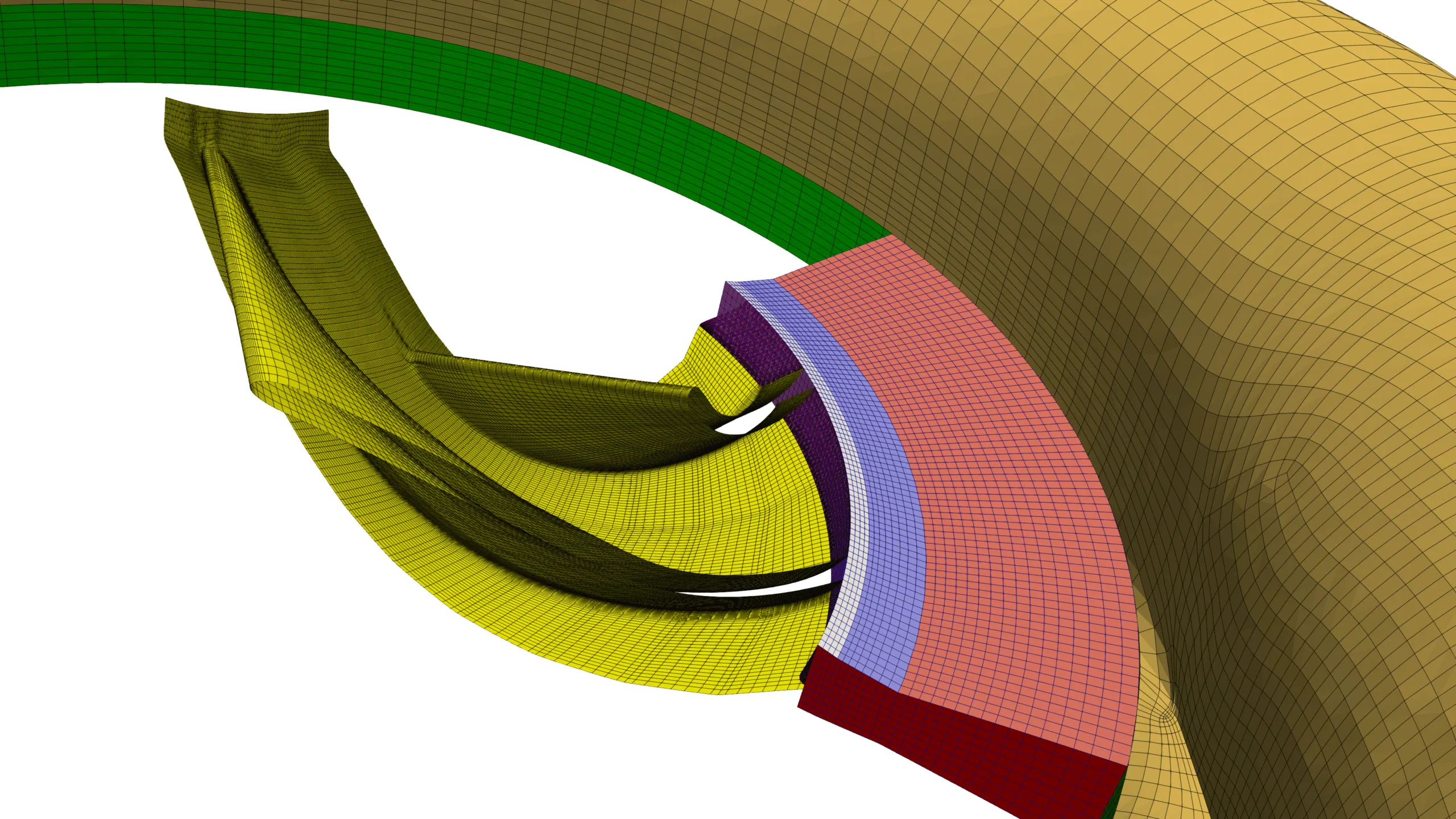
GridPro provides a specialized platform for structured hexahedral mesh generation, optimized for complex geometries like those in centrifugal compressors. Its topology-based approach allows engineers to define reusable block templates that can be adapted to different impeller shapes, diffuser configurations, or refrigerant conditions. This flexibility accelerates geometry-to-mesh workflows, making it easier to manage design iterations.
One of GridPro’s key strengths lies in boundary layer control. With fine resolution settings, engineers can maintain strict y+ targets while smoothly transitioning from near-wall elements to the outer domain. This is particularly useful when working with turbulence models and wall heat transfer, both of which are critical for compressors handling refrigerants with large thermal gradients.
GridPro also supports wake refinement and shock-fitting capabilities. These features are essential for accurately capturing flow structures behind blade trailing edges and in regions of sudden expansion or compression. For example, in compressors operating with high-pressure refrigerants, these mesh refinements help capture oblique shocks and shear layers without excessive numerical dissipation.
GridPro also offers an automation solution specifically valuable for centrifugal compressor design: GridPro Xpress Blade. This tool enables automatic generation of structured multiblock meshes for impeller blades, streamlining the creation of high-quality meshes that align closely with blade geometry. Xpress Blade is programmed to produce solver-ready meshes with minimal manual input. For engineers performing iterative simulations across varying blade profiles or refrigerants, this tool significantly shortens meshing time without compromising grid fidelity. Its ability to consistently generate mesh blocks around blades, splitters, and trailing edge regions enhances wake capture and overall mesh convergence. As a result, Xpress Blade helps integrate mesh generation seamlessly into automated design and optimization workflows.
GridPro meshes are compatible with major CFD solvers like ANSYS CFX, Fluent, OpenFOAM, and STAR-CCM+, which streamlines downstream simulation efforts. Engineers can also incorporate GridPro meshes into automated parametric studies and optimization frameworks using Python or third-party integration tools, ensuring scalability across projects.
Conclusion
The transition to low-GWP refrigerants in centrifugal compressor applications brings with it a set of complex engineering challenges. Meeting performance goals while ensuring sustainability and compliance requires a deep integration of CFD, real gas modeling, and high-quality structured meshing.
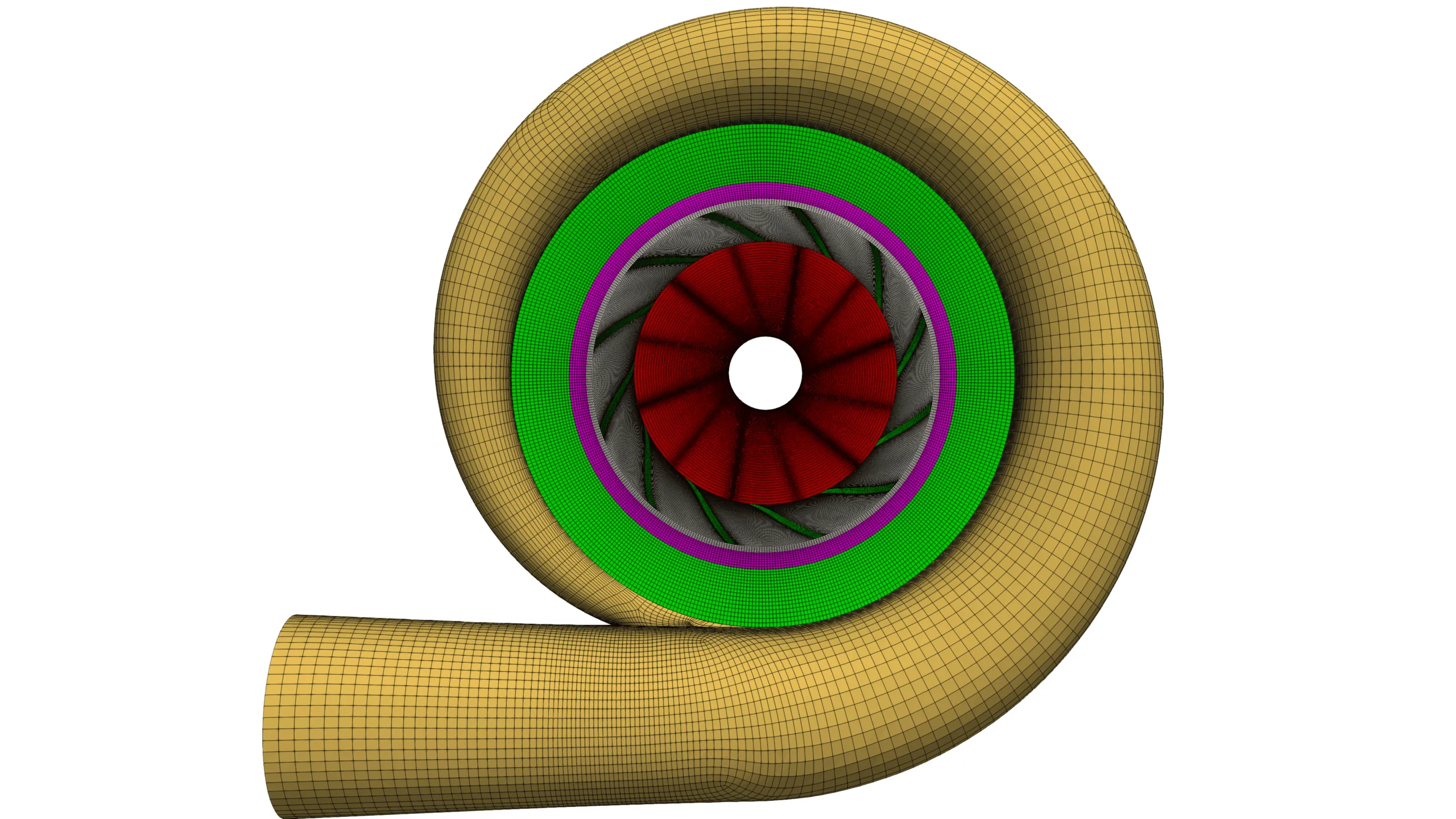
Structured hexahedral meshes—and specialized tools such as Xpress Blade—provide the fidelity and flexibility necessary to simulate and optimize modern compressor designs. For engineers and R&D leaders in the heat pump sector, investing in robust meshing strategies is a foundational step toward reliable, efficient, and future-ready product development.
Further Reading
- Enhancing Turbocharger Efficiency with CFD and Automated Meshing Tools
- Automated Hexahedral Meshing of Gerotor Pumps
- Automated Hexahedral Meshing with GridPro: Structured Meshes for Parametric Geometry Variants
References
1. “Centrifugal compressor design and cycle analysis of large-scale high temperature heat pumps using hydrocarbons“, Antti Uusitalo et al, Applied Thermal Engineering 247 (2024) 123035.
2. “Design and CFD analysis of centrifugal compressor and turbine for supercritical CO2 power cycle“, Ashish Chaudhary et al, The 6th International Symposium-Supercritical CO2 Power Cycles, March 27-29, 2018, Pittsburgh, PA.
3. “DESIGN AND OPERATION OF A CENTRIFUGAL COMPRESSOR IN A HIGH TEMPERATURE HEAT PUMP“,
Benoît Obert et al, 5th International Seminar on ORC Power Systems, September 9 – 11, 2019, Athens, Greece.
4. ” Combining Thermodynamics-based Model of the Centrifugal Compressors and Active Machine Learning for Enhanced Industrial Design Optimization“, Shadi Ghiasi et al, 1st workshop on Synergy of
Scientific and Machine Learning Modeling, SynS & ML ICML, Honolulu, Hawaii, USA. July, 2023.
5. ” Study of Performance Changes in Centrifugal Compressors Working in Different Refrigerants“, YintaoWang et al, Energies 2024, 17, 2784.
6. “Design of centrifugal compressors for heat pump systems“, Meroni, Andrea et al, Applied Energy, 232, 139-156.
7. “The Characteristic of High-Speed Centrifugal Refrigeration Compressor with Different Refrigerants via CFD Simulation“, Kuo-Shu Hung et al, Processes 2022, 10, 928.
8. “Energy Characteristics of the Compressor in a Heat Pump Based on Energy Conversion Theory“, Yingju Pei et al, Processes 2025, 13, 471.
9. “CFD Simulation of a Centrifugal Compressor using Star-CCM+“, SAI ANIRUDH RAVICHANDRAN, Master’s thesis in Applied Mechanics, CHALMERS UNIVERSITY OF TECHNOLOGY, Göteborg, Sweden 2022.
10. “Design of the first stage of a centrifugal compressor with R1234ze(E) for heat pump in district heating“, Fois, Antonio, THRUST Master of Science, Master Thesis Project Report, 30 CET, Universitè de Liege Faculty of Applied Sciences Academic year 20202021.