
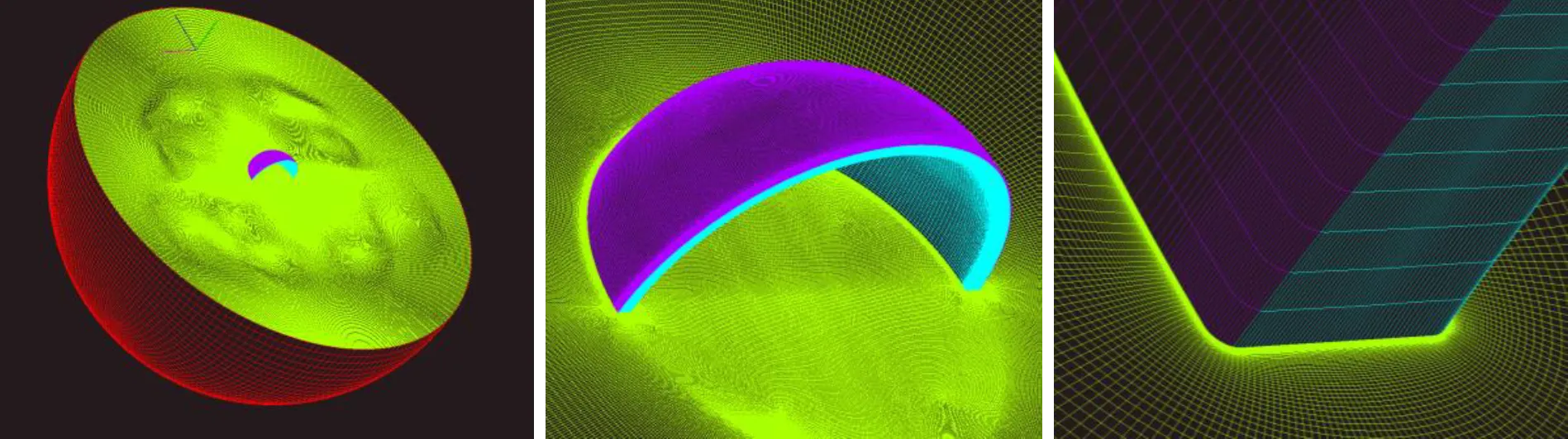
Figure 1: Space debris research: Structured multi-block mesh for a satellite. Image source – Mesh was generated by our French Distributor – R.Tech.
1581 words / 8 minutes read
What happens when space junk falls back to Earth—and how can we predict the impact before it’s too late?
With thousands of defunct satellites and rocket fragments orbiting Earth, space debris poses a serious threat. This article uncovers how cutting-edge CFD simulations and intelligent meshing strategies are being used to predict the reentry behavior of this debris—helping prevent disasters and protect both space assets and life on Earth.
Introduction
As space activity intensifies, Earth’s orbit is becoming increasingly cluttered with defunct satellites, spent rocket stages, and mission-related fragments—collectively referred to as space debris. These objects, once they complete their orbital life, often re-enter the atmosphere in unpredictable and dangerous ways. Understanding how this debris behaves during atmospheric reentry is critical for safeguarding both space assets and lives on the ground.
Computational Fluid Dynamics (CFD) has become a vital tool for simulating the complex flow and thermal environments experienced by these objects. However, the challenges of modeling irregular debris shapes, rapidly changing geometries, and dynamic trajectories require not only robust simulation techniques but also intelligent meshing strategies.
This article explores the need for space debris research, the role of CFD in this domain, the challenges it entails, and how tools like GridPro help address the meshing demands essential to such high-fidelity simulations.
The Need for Research on Space Debris
Research on space debris has gained urgency due to the growing threat it poses to satellite operations and public safety. As the number of man-made objects in orbit increases, so does the risk of collision and uncontrolled atmospheric reentry. In a worst-case scenario, known as the Kessler syndrome, a cascade of collisions could render certain orbits unusable. Moreover, as more debris is projected to re-enter the atmosphere in the coming years, predicting which objects will burn up and which might survive to reach Earth’s surface has become a major concern.
International guidelines, such as those from NASA’s Orbital Debris Program Office, stipulate that re-entering debris should pose no more than a 1 in 10,000 chance of causing harm on the ground. Current predictive models often fall short of this accuracy. Many use simplified geometries and outdated correlation models that underestimate heat rates or overestimate drag, resulting in uncertain survivability predictions.
To address these limitations, researchers are developing new methodologies that combine automated CFD computations, normalization techniques, and machine learning to create more reliable and comprehensive tools for assessing reentry risks.
How CFD is Used in Space Debris Research
CFD plays a foundational role in space debris research by providing high-fidelity data on aerodynamic characteristics and heat rates. This information is crucial for determining how a piece of debris will behave during atmospheric reentry, including its trajectory, velocity, angle of impact, and potential for ground damage. Traditional models, such as modified Newtonian theory, often fall short in accurately capturing complex flow phenomena, especially around concave or irregular geometries. CFD offers a superior alternative by simulating these intricate interactions with a high level of detail.
Modern CFD methods are capable of handling thousands of simulations across a wide array of shapes and flow conditions. These simulations often account for phenomena such as shock interactions, random tumbling motions, changes in wall temperature, and geometry transformations due to ablation.
Many CFD solvers solve full 3D Navier-Stokes or Euler equations and can model thermochemical non-equilibrium gas compositions typical of high-altitude reentry scenarios. Databases of non-dimensional parameters, such as drag coefficients and shape factors, are generated to aid in faster yet accurate risk assessments. CFD results are then validated using experimental data from hypersonic wind tunnels and free-flight testing, providing critical input for improving certification tools.
Challenges in CFD Simulations of Space Debris
Despite its advantages, the use of CFD in space debris simulations is not without significant hurdles. High-fidelity simulations are computationally intensive. A single simulation involving a six-degree-of-freedom model can take anywhere from 30 to 60 CPU-hours, making large-scale probabilistic assessments impractical using conventional approaches.
The tumbling nature of debris during atmospheric reentry introduces another layer of complexity, as the aerodynamic response varies significantly with object orientation. This requires simulations to be performed across numerous attitudes to capture an accurate average response.
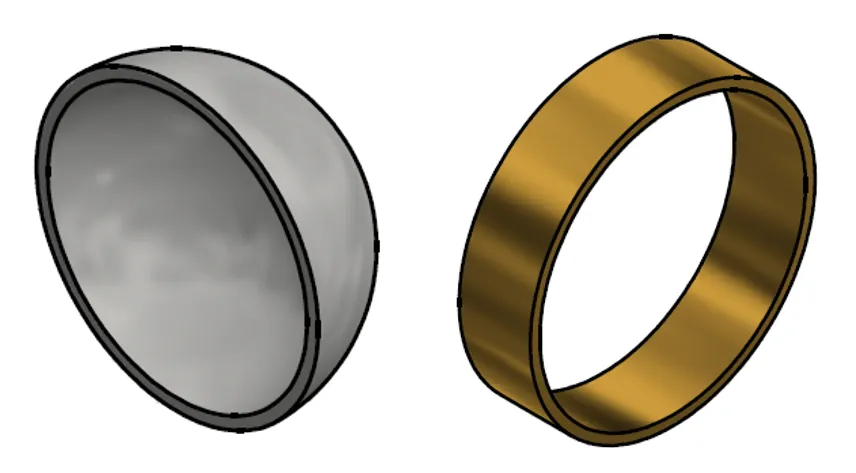
Moreover, the diversity in debris shapes—from hollow hemispheres to irregular fragments—poses a challenge for both modeling and simulation. These objects may undergo ablation, changing their geometry mid-flight, which complicates the simulation further. Accurately capturing the interaction between the flow and these complex surfaces necessitates high-quality meshes.
Simulating thermal behavior, shock-shock interactions, and catalycity adds even more to the computational burden. To manage this, researchers are increasingly relying on normalized databases and advanced interpolation methods, which allow the reuse of CFD results across different scenarios without rerunning the entire simulation set.
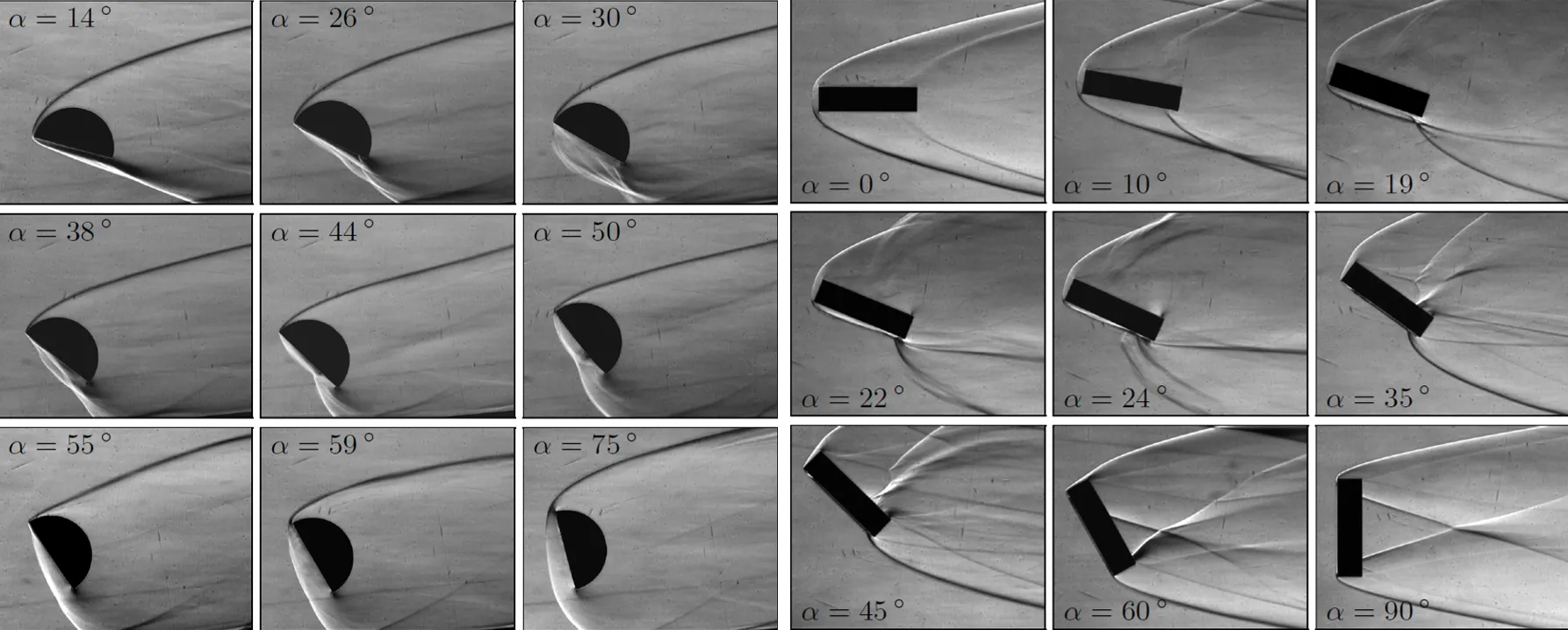
angles of attack emphasizing the presence of instabilities as the concave surface is gradually exposed to the incoming flow. b. Annular ring at different angles of attack illustrating the shock interactions taking place on the downstream part of the ring. Image source – Ref [2, R.Tech].
Meshing Challenges in These CFD Simulations
Generating accurate and efficient meshes is one of the most challenging aspects of CFD simulations for space debris. Debris objects are often irregular, with sharp edges, cavities, or thin structures that demand high mesh resolution to capture essential features. However, increasing mesh resolution significantly raises computational costs and can make subsequent data-driven models, such as neural networks, too complex to be practical. Striking the right balance between detail and efficiency is crucial.
Another challenge lies in the need to maintain a static mesh structure when using deep learning models. Once a mesh is created for a specific object, it cannot be easily modified to represent different sizes or shapes without disrupting the model’s structure. This limitation becomes particularly problematic when trying to simulate objects that undergo shape changes during ablation.
Furthermore, mesh quality must be high enough to ensure convergence of the numerical methods used in CFD, especially in regions with strong gradients such as heatshield shoulders. Under-meshing in these regions can lead to inaccurate predictions of temperature and pressure distributions, potentially compromising the entire simulation.
Meshing Requirements for Space Debris Simulations
To conduct meaningful CFD simulations on space debris, the mesh must meet several critical requirements. It needs to accurately capture the geometry of complex shapes and resolve important flow features such as shock interactions, recirculation zones, and expansion fans. The type of mesh used can vary depending on the simulation method. Unstructured meshes, are favoured for their flexibility and local control over mesh density. Cartesian meshes, valued for their fast generation time and compatibility with automated simulations, are also widely used.
However, structured meshes—particularly multi-block structured meshes—are gaining popularity due to their ability to deliver high accuracy with fewer cells. These meshes are easier to validate for grid convergence and allow for efficient simulation across varying angles of attack using techniques like the rotating mesh approach. For scenarios involving machine learning, a single mesh is often used for all possible orientations, with the outer boundaries typically designed as spheres to ensure accurate wake modeling. Reusability is another key factor; once a high-quality grid topology is established, it can be reused for similar shapes, significantly reducing meshing time for future simulations.
How Structured Meshes Are Favourable for These Simulations
Structured meshes offer several advantages that make them highly suitable for space debris CFD simulations. They enable the efficient resolution of complex flow features with fewer computational resources by maintaining a uniform grid quality. This type of mesh ensure high-quality results with a minimum number of cells. The block-based nature of these meshes allows them to adapt to various shapes without losing accuracy, making them ideal for modeling irregular debris geometries.
Structured meshes also support innovative modeling techniques such as the rotating mesh approach, where a single topology can be used to simulate various orientations of a tumbling object. This eliminates the need to generate new meshes for each attitude and help to automate the database generation from CFD computations. Overall, structured meshes strike a desirable balance between precision, flexibility, and computational efficiency, making them invaluable in the context of space debris modeling.
How GridPro Tools Facilitate These Simulations
GridPro plays a crucial role in facilitating high-quality CFD simulations of space debris by streamlining the meshing process and enhancing the overall efficiency of simulations. Its ability to generate massively multi-block structured meshes allows for the precise modeling of complex and irregular geometries commonly found in space debris. The grids produced are of consistently high quality, which is essential for ensuring numerical convergence and accurate resolution of physical phenomena during reentry.
One of the standout features of GridPro is its support for the rotating mesh approach. This enables researchers to simulate a complete range of angles of attack using a single mesh, significantly reducing the time and effort required to prepare for each new simulation scenario. Additionally, GridPro’s reusability feature allows users to apply the same grid topology to multiple objects with similar geometric layouts, further enhancing efficiency and consistency across simulations.
The block structure of the meshes also supports effective parallelization, making it easier to deploy simulations on high-performance computing clusters. This capability is particularly valuable when running hundreds or thousands of simulations for probabilistic analysis or database generation. Overall, GridPro acts as a critical enabler in the CFD workflow for space debris research, bridging the gap between geometric complexity and computational feasibility.
Conclusion
Space debris reentry poses significant risks that demand accurate and efficient predictive tools. CFD has proven to be a powerful method for capturing the complex aerodynamics and thermal behavior of re-entering objects, but the success of these simulations hinges on the quality and structure of the underlying mesh. Structured meshes, especially those generated with tools like GridPro, offer the precision, adaptability, and computational efficiency necessary for tackling the unique challenges presented by space debris.
As research continues to evolve, combining high-fidelity CFD data with advanced meshing strategies and machine learning will be essential for developing the next generation of risk assessment and mitigation tools. By doing so, the scientific community takes a critical step toward ensuring safer and more sustainable use of Earth’s orbital environment.
Acknowledgement:
This article is an outcome of the extensive work done on Space Debris by our French Distributor – R.Tech. We thank them for their valuable contribution to this article.
Further Reading
- Fast and Accurate Hypersonic CFD Simulations: Impact of Automatic Shock-Aligned Meshes
- Know your mesh for Hypersonic Intake CFD Simulations
- Supersonic Parachutes for Reentry Vehicles
- Know Your Mesh for Reentry Vehicles
References
- “CFD based interpolation of drag and heat rates of different objects reentering the earth atmosphere in a prescribed motion”, P. Van Hauwaert et al, HiSST: 2nd International Conference on High-Speed Vehicle Science Technology, 11–15 September 2022, Bruges, Belgium.
- “Aerodynamic characterization of space debris in the VKI Longshot hypersonic tunnel using a free-flight measurement technique”, G. Grossir, D. Puorto et al, October 2019, Conference Paper.
- “Space debris atmospheric entry prediction with spacecraft-oriented tools”, J. Annaloro et al, Proc. 7th European Conference on Space Debris, Darmstadt, Germany, 18–21 April 2017.
- “Next-Generation Re-Entry Aerothermodynamic Modeling of Space Debris Using Machine Learning”, Nicholas Sia et al, Master’s thesis, West Virginia University, Morgantown, West Virginia, 2021.
- “Characterization of Space Shuttle Ascent Debris Aerodynamics Using CFD Methods”, Scott M. Murman et al, 43rd AIAA Aerospace Sciences Meeting, January 10–13, 2005, Reno, NV.